





Applications for Ohio Farm Bureau Health Plans now available
Members have three ways to apply: contacting a certified agent, calling 833-468-4280 or visiting ohiofarmbureauhealthplans.org.
Read MoreSome aspects of the new two-year state budget will better protect farmers from nuisance lawsuits. Ohio Farm Bureau Policy Counsel Leah Curtis visits with Ohio Farm Bureau Director of Media Relations Ty Higgins about the language included in the budget and its importance to agriculture.
Listen to Legal with Leah, a podcast featuring Ohio Farm Bureau’s Policy Counsel Leah Curtis discussing topics impacting farmers and landowners.
Ty Higgins: In mid-July, Ohio legislators passed a new two-year, $69 billion state budget. It was signed by Governor DeWine shortly thereafter. The budget, as you might expect, mostly consists of a lot of numbers, adding some funds to programs, taking away funds from others. There’s also some language in the new budget that will be better protecting farmers from nuisance lawsuits. That’s our topic for this week’s Legal with Leah. Along with Ohio Farm Bureau Policy Counsel Leah Curtis, I’m Ty Higgins and Leah, you and I visited about there being an affirmative defense for farms enrolled in an ag district with some caveats. That came up not long after Toledo voters passed the Lake Erie Bill of Rights back in February. How does this budget address issues like LEBOR?
Leah Curtis: So what the budget did was it changed the nuisance protection just slightly so it does still apply to those who are enrolled in an ag district but also now would apply to those who are qualified and enrolled in the Current Ag Use Valuation program which a lot of people are going to do because it does make their taxes a little better. And so it just expands it a little bit and reduces a little bit of that paperwork burden. If you’re already enrolling in CAUV, you don’t have to also necessarily enroll for the affirmative defense in the ag district. It removed a couple of the requirements as well, so it should be a little bit easier to take advantage of and that way farmers will be able to use the defense when a nuisance lawsuit comes around. Now again as we’ve always said with the LEBOR situation, we don’t know for sure that those lawsuits would be considered nuisance and whether this defense would be the slam dunk. But as I always say as lawyer, I want every farmer to have every tool in the toolbox that they can and so if there’s any chance it would work, we want farmers to be able to use this and have this at their disposal as needed.
Ty Higgins: And there are other tools. What are other affirmative defense examples that can apply for farmers?
Leah Curtis: So there’s a few. If you have a concentrated animal feeding operation permit through the large livestock program at ODA and you are acting in accordance with that and the best management practices in that permit, there is an affirmative defense under that. There’s also one for any claims that are related to the spreading of fertilizer, so long as you have an approved NMP (nutrient management plan) and you’re acting in accordance with your plan. That happened in compliance with the fertilizer certification program. And then lastly if you are sued for a nuisance claim related to manure, and again you have an approved NMP and you’re acting in accordance with it, then there also may be an affirmative defense available for you in that case.
Ty Higgins: The one thing we really want to stress here to our members is that affirmative defense in all of its forms doesn’t prevent someone from suing you.
Leah Curtis: Yes. So a lot of people will say this is a complete defense. I don’t like the word complete because the fact is that a defense…you can use it once somebody sues you but you can’t stop somebody from filing a lawsuit. That would violate their constitutional rights to access the courts. So it is there, once the lawsuit is filed, to help get that lawsuit taken care of in a more quick manner, hopefully reduce the need for lots of attorneys fees and get you out of the courthouse as quickly as possible.
Ty Higgins: Leah Curtis is policy counsel with Ohio Farm Bureau. This has been Legal with Leah. Thanks for listening. I’m Ty Higgins. We’ll see you down the road.



Members have three ways to apply: contacting a certified agent, calling 833-468-4280 or visiting ohiofarmbureauhealthplans.org.
Read More
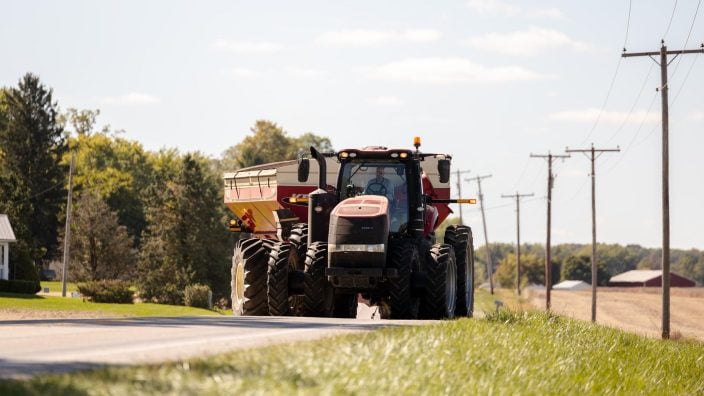
The executive order waives state penalties and suspends discretionary enforcement related to the use of dyed diesel on public highways through Dec. 31, 2026.
Read More

Maggie Preston, Lincoln Deitrick and Denver Davis describe their role in agriculture, their Farm Bureau involvement and what it means to win their respective state awards.
Read More
Associate General Counsel Leah Curtis breaks down the changes to Ohio’s fuel tax, recent guidance on dyed diesel and what farm families need to know.
Read More

Gripp is launching a 60-day cohort in mid-January for Ohio Farm Bureau members, offering discounted access to its asset-tracking app.
Read More
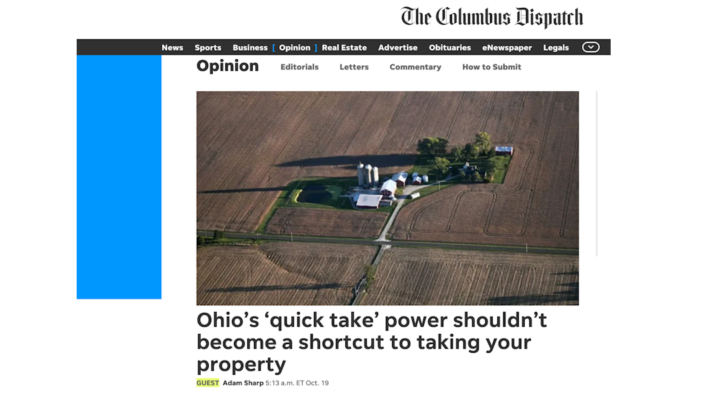
Ohio Farm Bureau recently published an op-ed in The Columbus Dispatch highlighting the importance of protecting private property rights as discussions continue around expanding eminent domain powers in Ohio.
Read More

These discussions should not begin and end with a developer’s offer. Identifying family goals now gives the family something to plan around.
Read More
Ohio Farm Bureau joined leaders from across Ohio’s food and agriculture industry this week to pack 10,000 meals for central…
Read More

The administration recently issued an executive order easing restrictions on the use of tax-exempt dyed diesel fuel for on-road agricultural transportation.
Read More

Ohio Farm Bureau Associate General Counsel Leah Curtis explains how the eminent domain process works in Ohio, what ‘quick take’ means and when it can be used.
Read More