






Ohio deer hunting options expand for landowners, hunters
The Ohio Landowner Hunter Access Partnership provides annual payments to landowners for providing hunting access to their property.
Read MoreThe Ohio Landowner Hunter Access Partnership provides annual payments to landowners for providing hunting access to their property. This article was reviewed and updated in November 2025.
Effective management of Ohio’s white-tail deer population depends on cooperation between the state’s landowners and hunters. To help bring the two groups together, the Ohio Department of Natural Resources administers a variety of programs to provide hunters access to land for hunting. Meanwhile, Ohio recreational user laws protect landowners from liability when they allow people to hunt on their property.
Deer and other wildlife species in Ohio are managed to balance the needs of the state’s diverse population, said David Kohler, program administrator with the Ohio Department of Natural Resources Division of Wildlife. Farmers and rural landowners, hunters and even motorists on the state’s roadways all have an interest in how deer are managed. About 7% of the state’s citizens are hunters, he added. However most of those hunters don’t own the land where they hunt.
The state’s program to link hunters with land was launched in 2021, funded in part by the federal farm bill under the Voluntary Public Access and Habitat Incentive Program. The Ohio Landowner Hunter Access Partnership provides annual payments to landowners for providing hunting access to their property, said Kohler. The program uses a reservation system that allows hunters to sign up for daily hunting permits the evening before they plan to hunt.
“We wanted to provide good quality hunting access on private land and pay the landowners for it,” he said.
The OLHAP program can be used for the daytime hunting of a variety of wildlife, but most of the hunters using it so far are hunting deer, Kohler said. In its first couple of years the program only allowed for the archery hunting of deer but not gun hunting on program lands.
Now, however, thanks to updates made to the program for the 2025/2026 season, a select few properties are available for deer hunting with a firearm during the deer gun seasons. To sign up, hunters must first obtain a valid hunting license. After a hunter has secured a hunting license, they may then apply for their annual OLHAP endorsement. Once they have received their endorsement, a hunter may then apply online for daily permits to hunt on OLHAP property through the ODNR website or mobile app starting at 8 p.m. the day before they wish to access a property. A permit gives the hunter access to the property between 5:30 a.m. and 10 p.m. “It becomes public land for those hunters for that day,” he said. Instructions on how to complete the online registration process can be found here.
Daily permits are issued between Sept. 1 to June 1 with the number of daily permits for a piece of property being limited to one person for each 50 acres. This gives hunters a better experience and assures landowners that their property won’t be overrun with hunters, Kohler said. “It’s all density-based,” he added. The landowners are kept in the loop with a notification each time a hunter is issued a permit for their land.
For Ohio landowners, the annual payment rates vary from $2 per acre for participating agricultural  land up to $32.50 per acre for perennial wildlife cover based on a scoring system that considers the habitat, size and location of the land. Forest and grassland, for instance, provides better habitat than crop ground, so it receives higher payments. Landowners can receive an additional $5 per acre when they allow deer gun hunting (all seasons) on the property.
In the first year of the program, Ohio enrolled 50 properties in 29 counties totaling 8,500 acres in the OHLAP program. As of 2025, according to the interactive OLHAP map, around 200 properties in 51 counties totaling over 29,000 acres are enrolled in the program.
OHLAP expands access to private land in the state, but hunters also have access to public hunting areas throughout the state, Kohler pointed out. Hunters can find some of the state’s best deer hunting opportunities on public land, especially if they are willing to seek out more remote locations.
ODNR offers additional chances to hunt through controlled hunts held in selected locations throughout Ohio. A lottery system is used to select hunters from those who apply for the controlled hunts.
Many hunters also contact landowners individually to arrange permission to hunt or to lease land for hunting. For all hunting on private land, hunters are required to obtain and carry permission, whether it is through OLHAP or from the landowner.
The issue of liability is a common concern for landowners when they’re deciding whether to allow hunting on their property. That concern led the state legislature to pass laws providing landowners with liability protection.
Hunting is one of the “recreational pursuits” specified in the law, along with fishing, trapping, camping, hiking, swimming and operating recreational vehicles. The law applies to nonresidential premises, so it doesn’t apply to a landowner’s home or the residential area around it. The law applies to other property such as fields, forests and streams as well as nonresidential buildings.
The law shifts responsibility for safety away from the landowner; under the law, when landowners give permission to hunters, the landowners don’t owe any duty to a recreational user to keep the premises safe for entry or use. And landowners don’t take on responsibility or liability for any injuries or property damage caused by an act of a recreational user, according to the law.
One key point is that the law does not require that a landowner keep their property open to the public at large to receive immunity. In some states, landowners must allow unrestricted access to enjoy liability protection, but Ohio law allows landowners to pick and choose who is allowed on their property and for what reason.
It’s important to keep in mind that the law protects landowners from liability, but that doesn’t mean someone can’t file a suit. What the law does provide is a defense if a lawsuit is filed. Landowners should still consult an attorney and respond if a suit is filed.
Even though a statute is in place to protect landowners, it’s important to keep common sense safety in mind.
Another point landowners need to understand is that the liability protection does not apply if a landowner accepts a “fee or other consideration” for hunting privileges. In other words, a landowner can’t charge admission and still enjoy the recreational user statute’s liability protection. However, the law does extend that liability protection to hunting leases, so landowners can lease their land without taking on more liability.
As protection for landowners participating in the OLHAP program, the OLHAP user agreement includes additional liability protection for participating landowners. Farm Bureau was a strong advocate for enhanced liability protection as a component of the program.
The recreational user law does not apply to trespassers who hunt without permission, but another section of Ohio law addresses that concern.
The regulations governing hunting in the state are updated annually, and ODNR publishes a hunting and trapping regulations summary booklet each year.
For the 2025-2026 season, deer bag limits have been updated*, and deer management permits can now be used to hunt antlerless deer on both public hunting areas and private property. Due to a recent legislative change, feral swine (wild boar) may no longer be hunted. The Disease Surveillance area to monitor Chronic Wasting Disease in deer has been updated.
For information about the Ohio Landowner Hunter Access Partnership, see the fact sheet. Additional information on Ohio’s hunting regulations, permission slips, buying hunting licenses, checking game and finding hunting locations can also be found online.
Hunters can use the HuntFish OH mobile app for licensing, checking game and communication with the Ohio Division of Wildlife through a mobile device. The app is available on Apple and Android/Google Play devices. A phone option is also available for tagging in game at 1-877-TAG-IT-OH (877-824-4864).
Violations of wildlife regulations can be reported online or by calling 1-800-POACHER (800-762-2437). For other questions, ODNR can be contacted by phone at 1-800-WILDLIFE (800-945-3543) or by email at [email protected].
Photos by Dave Liggett
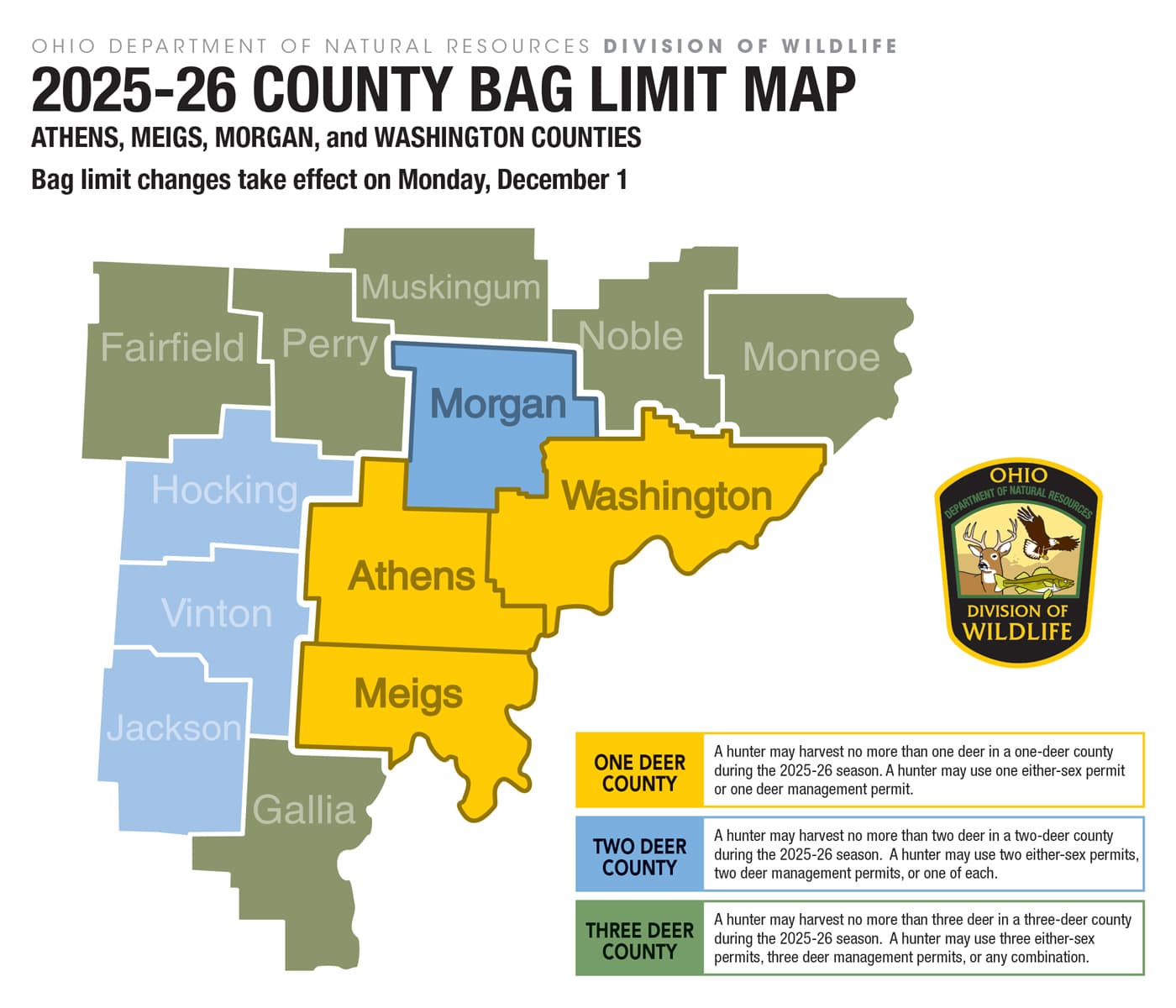
* On Nov. 12, 2025, the Ohio Wildlife Council approved new white-tail deer hunting limits in Athens, Meigs, Morgan, and Washington counties starting Dec. 1 and lasting for the remainder of the 2025-2026 season. This change was made in response to an outbreak of Epizootic Hemorrhagic Disease (EHD) in that area. Hunters in these areas should refer to the 2025-26 County Bag Limit Map for more information.
Access more topics pertinent to Ohio landowners with Ohio Farm Bureau’s Landowner Toolkit




The Ohio Landowner Hunter Access Partnership provides annual payments to landowners for providing hunting access to their property.
Read More
Leasing property for hunting and similar outdoor recreation has proven for many to be an attractive option when it comes to generating additional revenue for landowners, while also granting greater access to the outdoors.
Read More
What rifle calibers are legal for Ohio deer hunting? Learn about straight-walled cartridges hunting laws.
Read More
The new program helps connect landowners and hunters through incentives and opens many more acres of land to Ohio’s hunting enthusiasts.
Read More
Relief may be available for landowners suffering damage to their crops, gardens or ornamental trees because of deer.
Read More