Ohio Soybeans Summer 2023

The CAUV or Current Agricultural Use Value program, where farmland is taxed at a rate that reflects its value for agricultural purposes instead of its value as development property, is increasing once again in 2025. For this Legal with Leah, get an update on CAUV values with Ohio Farm Bureau Associate General Counsel Leah Curtis.


Ohio Farm Bureau · Legal with Leah – CAUV Increases Continue


Listen to Legal with Leah, a podcast featuring Ohio Farm Bureau’s Policy Counsel Leah Curtis discussing topics impacting farmers and landowners.

Transcript

Ty Higgins [00:00:00] The CAUV, or Current Agricultural Use Value Program, where farmland is taxed at a rate that reflects its value for ag purposes instead of its value as development property, is increasing once again in 2025.

Ty Higgins [00:00:22] As a reminder, every year a group of counties go through a change in property values. Can you just remind us what that is?

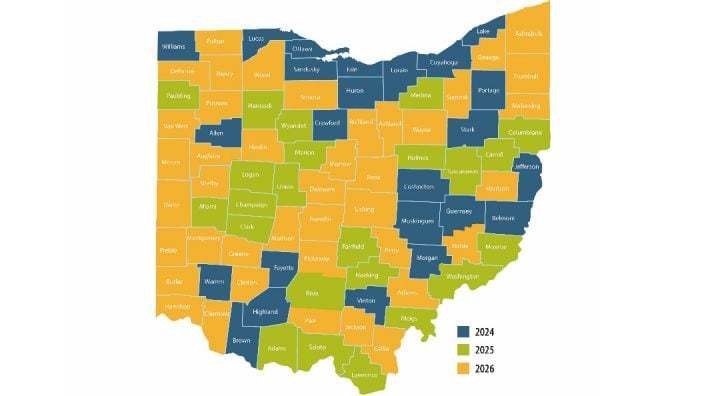
Leah Curtis [00:00:31] Every six years a property has a property tax reappraisal, and then every three years after that there’s what’s called the triennial update. But for CAUV values it doesn’t really matter which one it is. Every three years CAUV values are updated using that CAUV calculation. So in 2025 we have about 21 counties going through a reappraisal or update, and because we pay taxes one year behind, they will see those new property tax bills in January of 2026.

Ty Higgins [00:00:57] As I mentioned, it’s unfortunate, but we are going to see increases in CAUV values for those on the 2025 revaluations.

Leah Curtis [00:01:16] Yes, so like we’ve seen in the last two years for those other counties that have been on re-evaluation, this year there is an increase in those CAUV values of about 50%. Increases in value are going to vary, and I want to remind everyone that the increase in value is not the same as the increase in taxes. So the increase in taxes is generally less than the increase value. That’s due to the way we have controls on our property taxes, controls on levies, and how much can be collected.

Ty Higgins [00:01:33] Remind us, how do we get these numbers? How do CAUV values work and how do they apply to our properties?

Leah Curtis [00:01:40] So our CAUV values are determined based on a calculation that considers only agricultural data. So CAUV values are not influenced by increased development in your area or from land sales that have happened for homes or for businesses or development of any kind. All of those things can impact your market value, which is applied and used for taxation of your home, but it will not apply to CAUV and CAUV only considers those agricultural factors. There is a value for every soil type, and so your CAUV value is unique to your farm because it is going to be based specifically on the soil types that you have present on your land.

Ty Higgins [00:02:19] So what is it about the past three years where we’ve seen these values go up for all these counties across Ohio? What’s happening in the marketplace? What’s happening in the value system that’s making those values go up?

Leah Curtis [00:02:31] Well, as we’ve talked about over the last couple years, the CAUV calculation uses a seven-year historical data look back when we’re doing these calculations. We average numbers, we always drop out high and low and average the remaining five. So within those seven years, we do have fairly strong, steady years of relatively higher crop prices and increasing yields in that seven-year period. CAUV follows the farm economy and so as the farm economy was really strong in many of those years that influences our values and moves them up going forward. Now we are starting to see on the year-over-year calculations that values are slowing, they’re stagnating and that’s because we now have enough years we’ve kind of reached that tipping point of moving away from those years of higher crop prices and increased yield to lower crop prices and higher input prices and they are making a change then in our CAUV values.

Ty Higgins [00:03:23] It’s not all doom and gloom; there’s a little good news too, especially when it comes to woodland values.

Leah Curtis [00:03:28] So we talked about this a little bit last year, but because of advocacy from Farm Bureau, along with our partners at the Ohio Forestry Association, and after 10 years of litigation, the tax department did update the cost inputs that are used for woodland values. So while crop inputs are updated every year, those specific woodland cost deductions for clearing and drainage were not being updated annually. Again, due to advocacy from us and others, they are now updating that annually. And so all woodland values are at the minimum value that’s $230 per acre for those on the 2025 revaluation. Now, for some people your woodland may have already been at that minimum value because somewhere around 40% of woodland values were already at that point. But for a number of more productive soils in particular, this is going to be a significant reduction down to that new minimum value.

Ty Higgins [00:04:16] Aside from CAUV, property taxes a very hot topic right about now. Give us a quick rundown of what’s happening and where our members can get more information.

Leah Curtis [00:04:25] Property values in general, not just for CAUV, have increased statewide. And I think we’re still seeing that even for market values in a lot of counties, at least that’s what I’m hearing. And that in turn increases property taxes across the board. So there are dozens of proposals out there about property tax reform from the Legislature. The governor has convened a property tax reform committee. So we at Farm Bureau, we are staying engaged with all of this. We’re reviewing all those bills, all those proposals. Both with an eye to making property tax affordable, because of course that’s the number one concern there, but also most importantly for us, protecting CAUV and making sure that CAUV remains the important tool that it is, particularly for farmland preservation. So we have a number of resources on our website, both generally about property taxes and about CAUV. We have some past CAUV webinars that really deep dive into the program and the calculation and how it works. And everybody can access those through our website to get that information.

Online extra

CAUV information from Ohio Farm Bureau


To grow a network and gain perspective and knowledge in the industry through personal and professional development has been invaluable. Every day I learn and grow.
Ryanna Tietje's avatar
Ryanna Tietje

Henry County Farm Bureau

Farm Bureau connections
The issue of property taxation remains as one of the biggest challenges our members face today. Ensuring agricultural property is valued for its agricultural potential and not development is critical to the continued success of Ohio agriculture.
Matt Aultman's avatar
Matt Aultman

Darke County Farm Bureau

Giving farmers a voice
Farm Bureau is what really got the word out. It’s been one of their goals to get this done.
Bill and Charlotte Wachtman's avatar
Bill and Charlotte Wachtman

Henry County

10-year campaign for safer roads
I could not have done it without the resources I have found through Farm Bureau.
Gretchan Francis's avatar
Gretchan Francis

Trumbull County Farm Bureau

Bringing the farm back to life
Because we are younger farmers just starting out, Farm Bureau has a lot of good opportunities and resources to help us grow in the future.
Hannah Kiser's avatar
Hannah Kiser

Sandusky County Farm Bureau

Farm Bureau involvement
Through the Select Partner program, we became educated in farm insurance and weren't just selling policies. It became more and more clear why farmers need an advocate like Ohio Farm Bureau.
Chad Ruhl's avatar
Chad Ruhl

Farm manager, CSI Insurance

Select Partner Program
So many of the issues that OFBF and its members are advocating for are important to all Ohioans. I look at OFBF as an agricultural watchdog advocating for farmers and rural communities across Ohio.
Mary Smallsreed's avatar
Mary Smallsreed

Trumbull County Farm Bureau

Advocacy
Suggested Tags: