







Don’t raise a stink over insect’s emergence
Stink bugs also known as the Brown Marmorated Stink Bug (BMSB in the entomology world) are one of the earliest signs of spring to me here in Ohio.
Read MoreHave you ever had guests quickly overstay their welcome like cousin Eddie in the movie “Christmas Vacation”? That’s how I feel about liquid lime.
Some companies selling these products promise increased yields, better soil pH, increased calcium and only with five gallons per acre. While some of these claims are partially true, they are generally exaggerated with misleading claims.
The liquid “lime” that you can find advertised online is typically going to be one of two products: calcium nitrate or calcium chloride.
Let’s break down calcium nitrate first and see where some of the misleading claims originate. Calcium nitrate is created from treating limestone with nitric acid and neutralizing with ammonia. After this process, you are left with two plant nutrients in the molecule — calcium and nitrogen.
The nitrate part of the molecule is an excellent source of nitrogen that is readily available for plants to take up at time of application. It is widely used in Europe for this reason. Another advantage of calcium nitrate over other sources of nitrogen is that it does not acidify the soil during application like urea, or other nitrogen sources.
Here is where the facts get construed for marketing purposes — the fact that calcium nitrate is created from limestone doesn’t make it an effective liming product. Limestone is also used to create concrete, but that doesn’t make it a lime substitute.
For every five gallons of calcium nitrate you apply (which is the advertised rate per acre), you get the equivalent of applying 10 pounds of lime to that same acre. That’s it — 10 pounds. Most lime recommendations for our area are 4,000 pounds per acre, so you would need about 2,000 gallons of calcium nitrate to give you the same outcome. You can do the math on the cost of that one.
Products that are based on calcium chloride have the same problems as calcium nitrate, but at least with calcium nitrate you get some nitrogen out of the application. Calcium chloride is the same stuff they use to de-ice the roads. If you apply this in substantial quantities to your fields, you are effectively salting your fields, which may burn any plants or seeds out there. While you may get some calcium out of an application, it is typically not worth the application cost as you will not get any change in soil pH.
So why won’t liquid “lime” pack up the RV and ride off into the sunset? It is being marketed toward smaller farming operations that may not have the equipment to spread true lime, or operations with financial constraints.
To apply a liquid, and at the advertised five gallons per acre, you could almost apply to any sized field with a backpack sprayer or inexpensive ATV sprayer. This makes it financially attractive on the surface, but when you learn more about the product, you realize its actually not that great of a deal.
I also need to stress that a soil test should be done on any fields (or gardens) before lime is added. I have seen too many soil test results show that owners have over-applied lime, which then requires the owner to apply sulfur to drop the pH.
In a nutshell, the great claims about liquid lime are only half true. If you are looking to lime your property to raise your pH and are not sure which product is best to use, give me a call at 330-638-6783. We can talk about all the options, and we can find one that fits your operation and budget.
We have some great educational opportunities coming up in March. On March 7, we will be “Pruning into March” at Hartford Orchards. We will discuss and demonstrate how to prune fruit trees. We will start with an overview of the pruning process before heading out into the orchard for hands-on experience. We will be outside. So dress for the weather.
If you are thinking about taking the exam for a pesticide applicators license, OSU Extension will offer a test prep class on March 2. You will learn about the test, and we will cover topics that are covered in the exam.
Lastly, mark your calendars for March 11 as OSU Extension’s Agronomy School returns to Bristolville. Topics for the day include precision ag on a budget, economic updates, weed control, soybean maturity selection and Ohio’s new H2Ohio program.
For information, or to register for any program, call OSU Extension at 330-638-6783.
Stay safe out there.
Submitted by Lee Beers, OSU Extension Educator. He can be reached by email or by calling 330.638.6783.
OFBF Mission: Working together for Ohio farmers to advance agriculture and strengthen our communities.




Stink bugs also known as the Brown Marmorated Stink Bug (BMSB in the entomology world) are one of the earliest signs of spring to me here in Ohio.
Read More

Through all of life’s changes, Trumbull County has become not just a place we work, but the place we call home.
Read More

Most livestock animals are well adapted to cold weather, but farmers take extra measures when extreme temperatures come.
Read More

We often talk about the moments that shape us — big decisions, career paths and life milestones. But more often than not, it’s not the moments that define us. It’s the people.
Read More

The purpose of this $1,500 grant is to help offset farm operation costs. This can include but is not limited to: fuel costs, fertilizer costs, equipment costs, land rent, etc.
Read More

I’m going to give you a list of things that you can do that will get you outside and actually enjoy the snow.
Read More

As kids, we are often told to try new things, whether it be a new food, a new activity or…
Read More

Learn more about ag districts from noon to 4:45 p.m. Jan. 28 at the OSU Extension Office, 520 W. Main Street in Cortland.
Read More
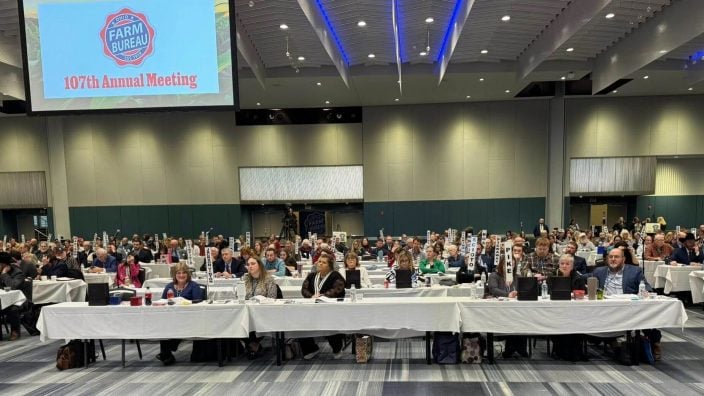
We aren’t just reacting to change — we’re shaping the future of agriculture, one conversation and one decision at a time, together.
Read More

Today, there are close to 15,000 farms growing Christmas trees in the U.S., and over 100,000 people are employed full- or part-time in the industry.
Read More