






What the One Big Beautiful Bill means for Ohio agriculture
Overall, $65.6 billion from this aid package is projected to increase agriculture-focused spending over the next decade.
Read MoreWhile margins and conditions remain tight, agriculture was given a step toward certainty last year with the One Big Beautiful Act. Overall, $65.6 billion from this aid package is projected to increase agriculture-focused spending over the next decade, according to the nonpartisan Congressional Budget Office. The legislation included much-needed updates to reference prices, permanence and enhancements to critical tax provisions, support to domestic biofuel markets and investments in conservation, research and trade.
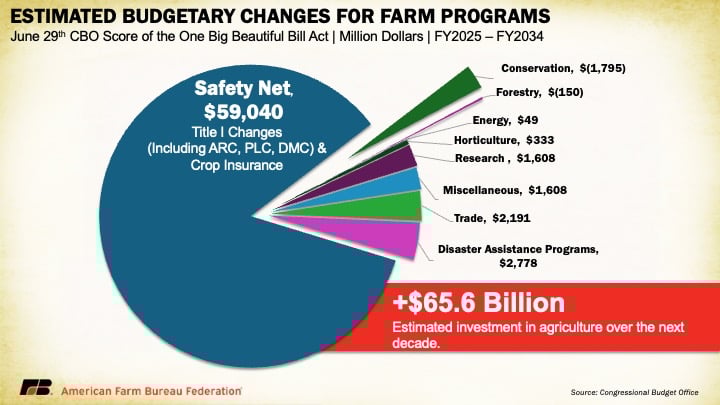
On the federal level, the bill included $54 billion in Agriculture Risk Coverage (ARC) and Price Loss Coverage (PLC) to reflect market realities, nearly $6 billion for enhanced crop insurance premium support, $1.25 billion invested in agricultural research at public land-grant universities and over $2 billion to support American producer access to essential export markets.
As far as tax provisions, the bill includes a nearly tripled estate tax exemption, a permanent increase to the 199A deduction, permanent bonus depreciation (expensing) extension and permanently lowered individual tax rate.
Ohio Farm Bureau, in-line with American Farm Bureau advocacy efforts, pushed hard to ensure that these critical tax provisions were addressed and modernized before their 2025 expiration date and created a massive loss of generational family farms and agricultural businesses.
The U.S. House Committee on Agriculture recently released an interactive map to break down how each state will potentially benefit from the One Big Beautiful Bill Act. Many of these programs are forthcoming and will help build momentum to a long-term fix of the farm economy.
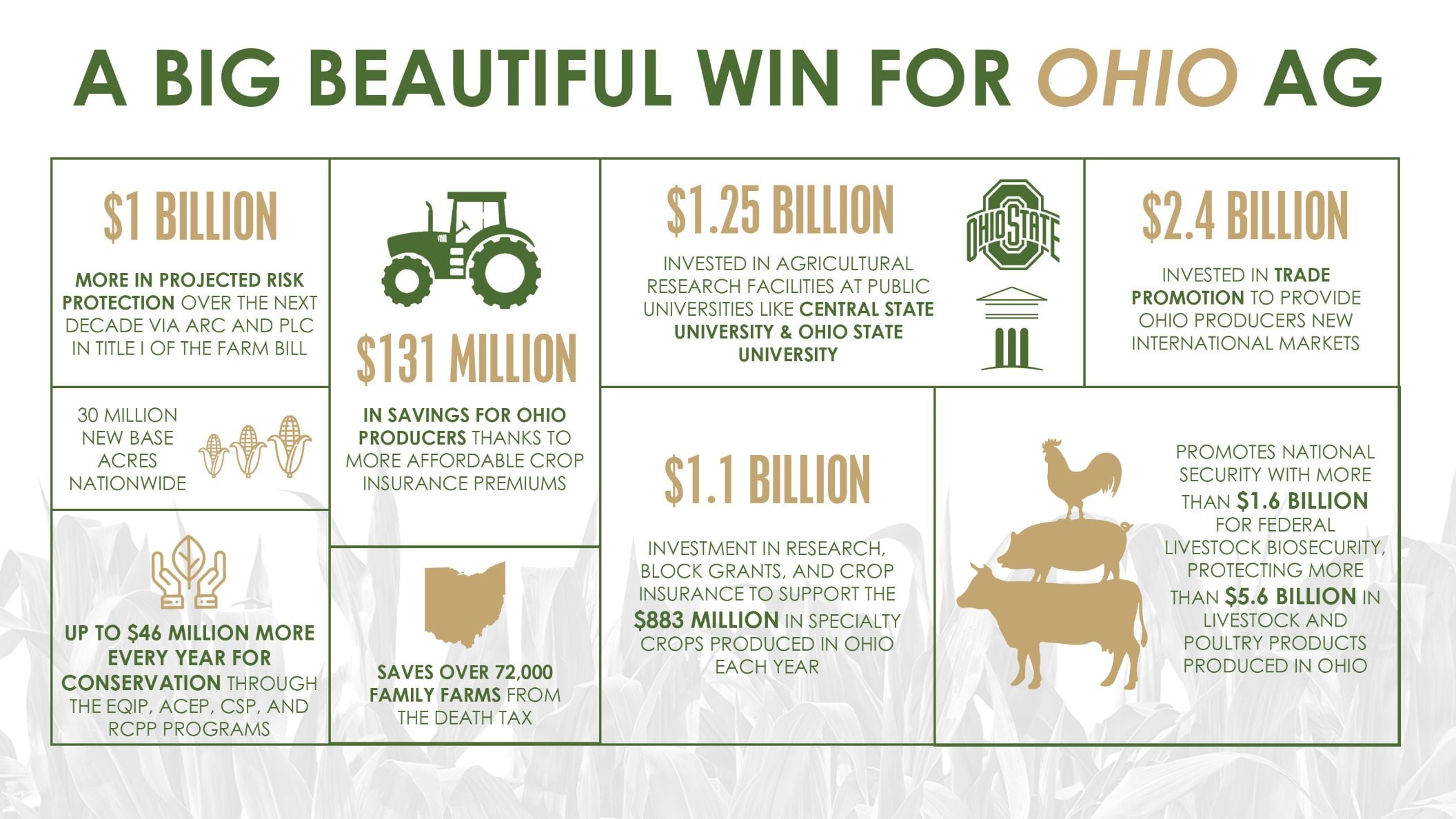
Ag wins specific to Ohio per USDA:
All of the legislative wins in OBBBA, along with the short-term aid of the Farm Bridge Assistance Program, will prevent many Ohio farm farms from closing their doors this year. Looking ahead, however, farmers still face record-low crop prices, nearly record-high input costs, market uncertainty and other farm bill programs that have not modernized since 2018.
“If we want agriculture to thrive, and finally get farmers profitable again, we need our state and federal leaders to bring long-term certainties. Our families, our communities and our nation’s food security depend on it,” said Adam Sharp, executive vice president for Ohio Farm Bureau.


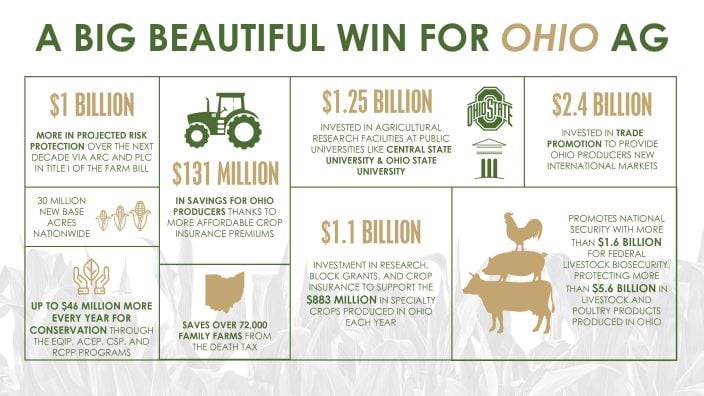
Overall, $65.6 billion from this aid package is projected to increase agriculture-focused spending over the next decade.
Read More

Get an update on recent headlines in agriculture as we sit down with Brad Bales, Ohio Farm Bureau senior director of state and national policy.
Read More

Urge President Trump and Congress to act before the end of 2025 to provide immediate relief and long-term stability for America’s farmers and ranchers.
Read More

A proposal to import beef from Argentina comes on top of the government shutdown and ongoing economic pressures facing agriculture.
Read More

Ian Sheldon and Brent Sohngen take a look at the causes of inflation and how energy markets will impact agriculture, respectively, in the latest Ohio Farm Bureau Podcast.
Read More
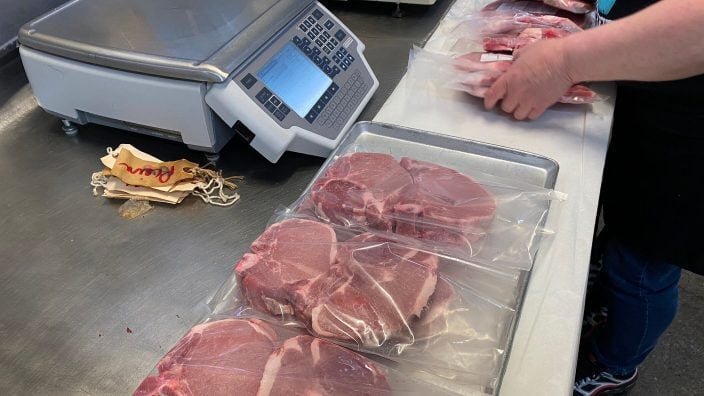
Earlier this week, the Ohio Controlling Board approved $18 million to be allocated to the Ohio Meat Processing Grant Program.
Read More
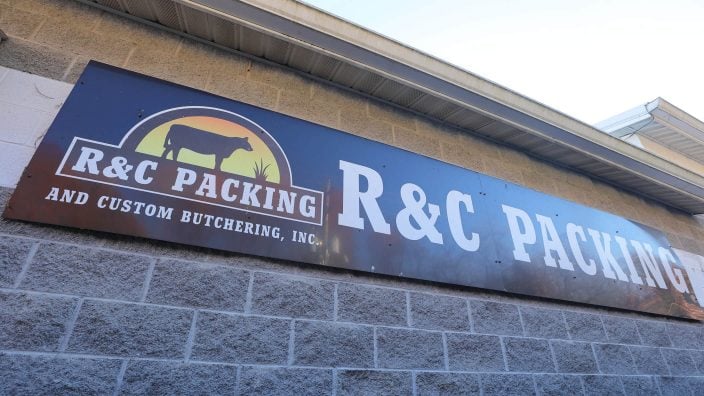
Ohio meat processors like Jamie Graham, owner of R & C Packing, have been hard pressed to keep up with demand for their services. Consumer interest in locally raised meat has been steadily increasing in recent years, and the COVID-19 pandemic boosted demand further.
Read More
The American Farm Bureau Federation sent a letter to the U.S. House of Representatives Tuesday stating its opposition to the Build Back Better Act, also known as the reconciliation package.
Read More
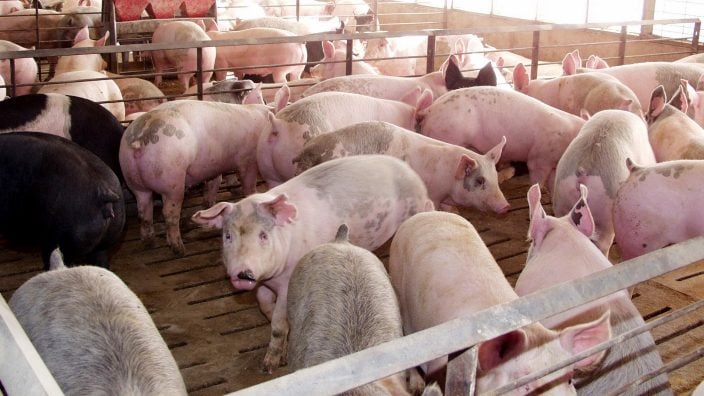
A recent court ruling will reduce pork line speeds through the New Swine Inspection System (NSIS).
Read More

While net cash farm income in 2020 was above the average net cash farm income for the 2013–2019 period, increased…
Read More